
TL;DR:
- Work-life balance travel planning involves organizing trips to combine professional commitments with personal recovery, ensuring you return refreshed. Booking flights first and using a split-schedule work approach helps create a productive, restorative workcation experience. Effective planning, flexible bookings, and work-friendly accommodations prevent burnout and maximize leisure during travel.
Work-life balance travel planning is the practice of organising trips to harmonise professional commitments with personal restoration, so you return home refreshed rather than exhausted. The industry term for this is “workcation” planning, though bleisure travel (blending business and leisure) covers the broader spectrum. Done well, it reduces burnout, protects productivity, and turns your annual leave into genuine recovery time. Done poorly, it leaves you answering emails from a sun lounger while missing the view entirely. This guide gives you the frameworks, tools, and scheduling principles to get it right every time.
What are the core travel planning principles that support work-life balance?
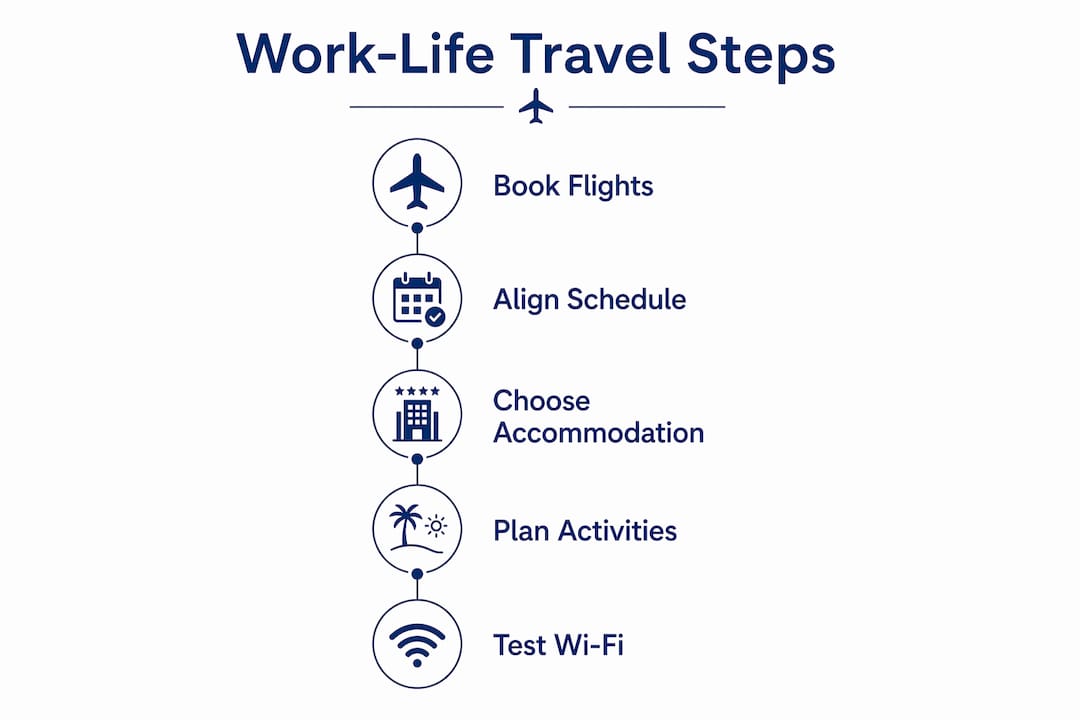
The single most important rule in effective travel planning is this: book your flights before anything else. Securing flights first builds the fixed travel dates that hold your entire itinerary together. Booking accommodation or tours before you have confirmed flights is a leading cause of double bookings, wasted deposits, and unnecessary stress.

Once your flights are locked in, timing matters enormously for both cost and peace of mind. Booking international flights 2–3 months in advance and choosing Tuesday to Thursday departures saves 20–30% on airfare. That saving is not trivial. On a family trip to Southeast Asia, it could cover an entire night’s accommodation or a guided day tour.
Match your budget to your travel style
Budget planning is where most professionals underestimate the effort required. Daily costs vary sharply by region and travel style:
| Travel Style | Region | Estimated Daily Cost |
|---|---|---|
| Budget | Southeast Asia | £20–£32 per day |
| Mid-range | Europe | £80–£145 per day |
| Comfortable | UK domestic | £100–£200 per day |
Budget travellers in Southeast Asia can manage on £20–£32 per day, while mid-range travellers in Europe typically need £80–£140 per day. Always add a 15% buffer for currency fluctuation, unexpected transport costs, or a spontaneous meal worth every penny.
Plan around your work schedule, not against it
The professionals who travel best are those who treat their work schedule as a fixed constraint, not an afterthought. Map your key meetings, deadlines, and time zone requirements before you choose your destination. A London-based consultant working with New York clients will find Southeast Asia genuinely difficult. The time difference forces either very early mornings or very late nights, which defeats the purpose of a restorative trip.
Pro Tip: Choose destinations within two to three time zones of your home base for your first workcation. It makes scheduling far less disruptive and gives you a realistic test of whether the format suits you.
Flexibility in your bookings is equally critical. Refundable fares and free cancellation accommodation give you room to adjust if a client deadline shifts. Rigid bookings create anxiety. Flexible ones create options.
How do you build an itinerary that balances work and rest?
A balanced itinerary is not a packed itinerary. The most common mistake busy professionals make is treating a workcation like a sprint through a bucket list. The result is exhaustion that rivals a normal working week.
The split-schedule approach is the most effective framework for combining productivity with genuine leisure. Working 7–11am and 5–8pm local time creates roughly six hours of focused work daily while leaving the core of the day free for exploration, rest, or family time. That structure is not accidental. It mirrors the natural rhythm of many destinations, where midday heat or local culture encourages a slower pace anyway.
Here is a practical five-step process for building your itinerary:
Block your work hours first. Add them to your calendar before you plan a single activity. They are non-negotiable.
Identify your anchor experiences. Choose two or three things you genuinely want to do or see. These are your priorities, not your entire programme.
Limit daily activities. Cap sightseeing at 2–3 activities per day, or just 1–2 for intensive experiences like long hikes or full-day tours. Itinerary fatigue is real and it ruins trips.
Build in transition time. Travel between locations, airport transfers, and check-ins all take longer than you expect. Leave gaps.
Plan at least one full rest day per week. No activities, no work. Just recovery.
The case for slow travel
Slow travel and extended stays enable routines that adapt to shifting environments and maintain balance far better than rapid destination-hopping. Staying in one location for a week or more lets you find your local coffee shop, establish a morning routine, and actually decompress. Families benefit especially from this approach. Children settle faster, and parents spend less time managing logistics and more time being present.
Tools like Apple Notes and Google Docs work well for itinerary planning because they sync across devices and are accessible offline. Keep your itinerary simple. A shared document with dates, accommodation addresses, and key booking references is more useful than an elaborate app you will abandon by day three.
What tools and platforms support work-friendly travel?
The right accommodation makes or breaks a workcation. A stunning view means nothing if the Wi-Fi drops during a client call. Dedicated ergonomic workspaces with smart-home features and reliable high-speed Wi-Fi increase productivity and reduce stress during workcations. When searching for accommodation, filter specifically for these features rather than treating them as a bonus.
Platforms like Wander specialise in work-friendly properties with dedicated desk setups, fast broadband, and smart-home technology. These are not standard hotel rooms with a desk shoved in the corner. They are designed for professionals who need to perform at full capacity while away from the office.
Here is a quick comparison of accommodation approaches for workcation travellers:
| Option | Best For | Key Advantage | Watch Out For |
|---|---|---|---|
| Serviced apartments | Families and longer stays | Kitchen, space, and routine | Fewer hotel-style services |
| Work-focused rentals (e.g. Wander) | Remote professionals | Ergonomic setup, fast Wi-Fi | Higher nightly cost |
| Business hotels | Short trips, city destinations | Reliable infrastructure | Limited leisure atmosphere |
| Standard holiday rentals | Leisure-first trips | Variety and value | Inconsistent Wi-Fi quality |
Beyond accommodation, a few practical tools make a real difference:
Currency and budget apps such as Revolut or Wise help you monitor spending in real time and avoid poor exchange rates.
Scheduling tools like Google Calendar or Calendly let you set visible working hours so colleagues know when you are available across time zones.
Refundable booking platforms give you the flexibility to adjust plans without financial penalty if work demands shift unexpectedly.
Pro Tip: Always test the Wi-Fi speed at your accommodation within the first hour of arrival. Use a free tool like Speedtest by Ookla. If it falls below 25 Mbps, ask reception for a router closer to your room or locate a nearby co-working space as a backup.
What are the biggest challenges in balancing work and travel?
The most persistent challenge in work-life harmony trips is not logistics. It is boundaries. Without a deliberate structure, work bleeds into every part of the day, and the trip delivers neither good work nor genuine rest.
Establishing fixed anchor hours and offline periods before you travel is the single most effective preventive measure. A “phone-in-drawer” policy during leisure hours sounds simple. In practice, it requires commitment, especially for professionals who have built their reputation on rapid responsiveness.
“A workation requires proactive design of workspace and schedule. Merely changing location won’t reduce burnout if home habits persist.” — Workcation Without Burnout
Several other challenges catch travellers off guard:
Working from leisure spaces. Answering emails from your hotel bed trains your brain to associate rest with work. Use a dedicated workspace, even if it is just a specific chair at a specific table.
Bleisure logistics. Bleisure travel planning works best when you treat the work and leisure portions as two joined but distinct trips. Plan family arrivals, visa requirements, and handoff days separately. Conflating them creates confusion and missed details.
Over-scheduling leisure. Professionals often compensate for guilt about taking time off by cramming their free hours with activities. This is counterproductive. Rest is not wasted time.
Ignoring health on the move. Disrupted sleep, unfamiliar food, and reduced exercise all compound travel fatigue. Build in time for physical activity and prioritise sleep over late-night sightseeing.
Intentional planning that includes insurance coverage and clear communication with your employer or clients before departure reduces anxiety significantly. Tell people when you will be unreachable. Set expectations early. The professionals who travel most successfully are those who manage their stakeholders as carefully as they manage their itinerary.
Key takeaways
Effective work-life balance travel planning requires booking flights first, capping daily activities, establishing firm work boundaries, and choosing work-friendly accommodation before anything else.
| Point | Details |
|---|---|
| Book flights before accommodation | Confirmed flight dates prevent double bookings and costly itinerary errors. |
| Use split-schedule work blocks | Working 7–11am and 5–8pm frees six hours daily for genuine rest and exploration. |
| Cap daily activities at 2–3 | Limiting sightseeing prevents itinerary fatigue and protects recovery time. |
| Choose work-friendly accommodation | Ergonomic setups and reliable Wi-Fi are non-negotiable for productive workcations. |
| Set boundaries before you travel | Written anchor hours and offline windows stop work from consuming leisure time. |
Why intentional planning beats spontaneous travel every time
I have spoken with hundreds of professionals over the years who swear by spontaneous travel. They love the freedom of it. And I understand the appeal completely. But when you are balancing a demanding job, a family, and a genuine need to recharge, spontaneity is often just another word for stress.
The trips that actually restore people are the ones that were thought through. Not over-planned, not rigid, but structured enough that the important things are protected. Your work hours are protected. Your rest time is protected. Your family’s experience is protected. That structure does not kill the joy of travel. It creates the conditions for joy to actually happen.
What I find most telling is how often professionals return from “spontaneous” trips feeling like they need a holiday to recover from their holiday. They over-scheduled, under-rested, and never fully switched off. Contrast that with someone who spent two hours planning a split-schedule template before they left and came back genuinely refreshed. The difference is not the destination. It is the intention behind the trip.
Treating travel planning as an extension of your professional life, with the same care and structure you would give a project plan, transforms the experience. You would not walk into a major client presentation without preparation. Do not walk into your annual leave without it either.
— Stuart Toogood
How Toogood Travel can handle the planning for you
Planning a trip that genuinely balances work and leisure takes time you probably do not have. That is exactly where Toogood Tavel comes in.

Toogood Travel handles everything from flights and accommodation to car hire and guided tours, so you can focus on the parts of travel that actually matter to you. Every trip is tailored to your schedule, your budget, and your priorities. With ATOL and PTS protection, flexible cancellation policies, and access to exclusive deals that online platforms simply cannot match, you get peace of mind alongside a genuinely brilliant holiday. Whether you are planning a family break, a workcation, or something a little different like one of our poker holiday packages, we have got you covered. Explore what you can book and let us take the planning off your plate entirely.
FAQ
What is work-life balance travel planning?
Work-life balance travel planning is the process of organising trips to integrate professional commitments with personal rest, using structured schedules and flexible bookings to prevent burnout and maximise leisure time.
When should i book flights for the best price and flexibility?
Book international flights 2–3 months in advance and choose Tuesday to Thursday departures to save 20–30% on airfare and secure the most flexible options.
How many activities should i plan per day on a workcation?
Limit yourself to 2–3 activities per day, or just 1–2 for intensive experiences. Capping daily sightseeing prevents itinerary fatigue and protects the rest time that makes travel genuinely restorative.
What is the best work schedule for a workcation?
The split-schedule approach of working 7–11am and 5–8pm local time creates six hours of productive work daily while leaving the core of the day free for leisure and recovery.
How do i prevent work from taking over my holiday?
Set written anchor hours and an offline policy before you travel. Bleisure travel works best when work and leisure portions are planned as two distinct experiences joined through careful logistics, not merged into one blurry week.