
TL;DR:
- Buffer days help absorb delays and protect high-stakes events in travel plans, making trips more enjoyable.
- Placing one or two buffer days strategically reduces stress, prevents cascading disruptions, and enhances overall experience.
Buffer days are defined as planned, unscheduled periods built into a travel itinerary to absorb delays, disruptions, and the unexpected. The role of buffer days in travel itineraries goes far beyond simply padding out a schedule. They are the difference between a trip that flows and one that unravels at the first cancelled flight or missed connection. Whether you are planning a short city break in Europe or a multi-leg adventure across Southeast Asia, understanding how to use buffer days transforms your itinerary from a rigid timetable into a genuinely enjoyable experience.
What is the role of buffer days in travel itineraries?
Buffer days function as insurance for your trip’s rhythm. They sit between major transit legs, before high-stakes events, or at the end of a holiday to give you breathing room when things do not go to plan. Think of them less as empty days and more as the structural support that holds the rest of your itinerary together.

The importance of buffer days becomes clearest when something goes wrong. A delayed flight, a missed connection, or a hotel that cannot check you in early can cascade through a tightly packed schedule, turning minor inconveniences into expensive, stressful disasters. Buffer days catch those cascades before they cause real damage.
Experienced planners treat buffer days as a non-negotiable part of any itinerary, not an optional luxury. The travellers who skip them are the ones frantically rebooking trains at midnight or missing the first day of a cruise because their inbound flight was delayed. That is not a risk worth taking.
How many buffer days should you include, and when?
The right number of buffer days depends on your trip type, destination complexity, and what is at stake if something goes wrong. A general rule is straightforward: 1–2 days based on risk profile is the standard recommendation used by experienced travel planners.
For a short European city break of three to five days, one buffer day is typically sufficient. You are dealing with a single flight, familiar infrastructure, and limited transit complexity. One cushion day at the end of the trip covers most realistic disruption scenarios.
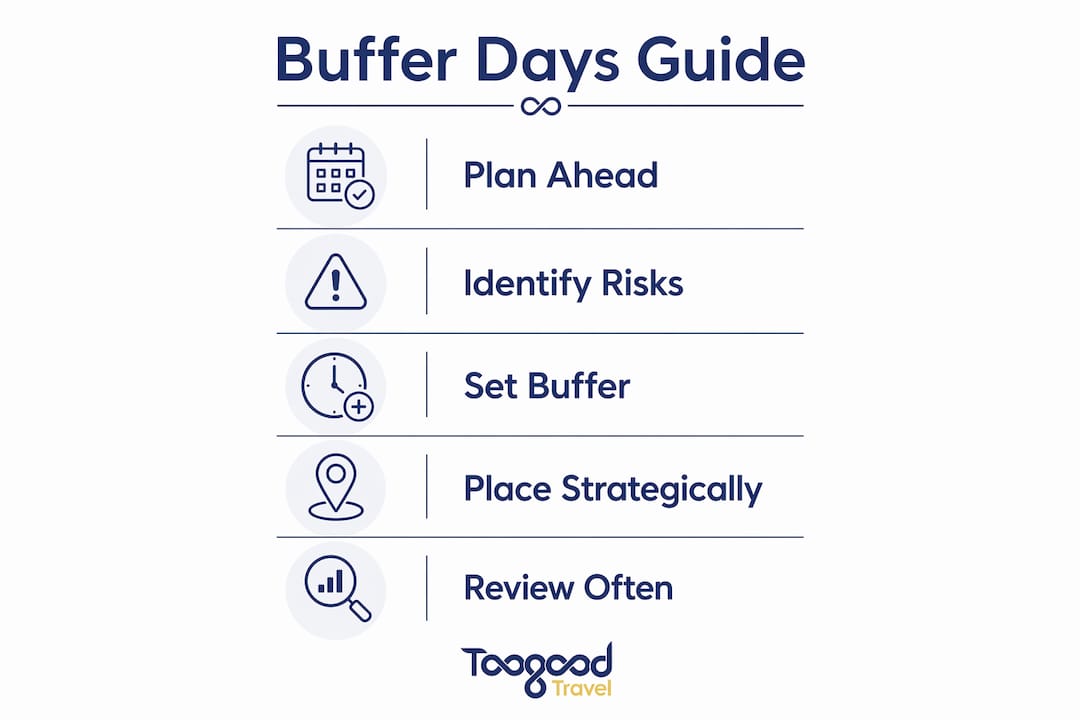
For high-stakes travel, the calculation changes entirely. Cruises, destination weddings, and multi-centre itineraries all carry a much higher cost of disruption. Missing a cruise departure because of a delayed flight is not just inconvenient. It can mean losing thousands of pounds with no recovery option. In these cases, two buffer days are advised, ideally placed before the critical event rather than after it.
| Trip type | Recommended buffer days | Best placement |
|---|---|---|
| Short European city break | 1 day | End of trip |
| Long-haul holiday (10+ days) | 1–2 days | After main transit leg |
| Cruise departure | 2 days | Before embarkation day |
| Destination wedding | 2 days | Before the ceremony date |
| Multi-centre itinerary | 1 day per major leg | Between each destination |
Destination complexity also matters. Travelling through countries with less predictable infrastructure, monsoon seasons, or limited flight options increases your disruption risk considerably. A trip to rural Vietnam or the Maldives during changeable weather periods warrants more buffer time than a direct flight to Lisbon.
Practical timing strategies: the 20-minute rule and beyond
Knowing you need buffer days is one thing. Knowing how to apply them within your itinerary is another. The most practical starting point is the 20-minute rule: add 20 minutes to each transit stage of your journey, including car hire collection, airport parking, check-in queues, and security. This single habit turns what would otherwise be stressful near-misses into comfortable transitions.
The psychological case for this rule is compelling. Incremental delays cause more stress than a single large delay because they force constant mental renegotiation of your schedule. Adding 20 minutes per stage removes that mental load entirely. You arrive at each stage with time to spare rather than time to panic.
Beyond the 20-minute rule, here are the most effective timing strategies for building buffer days into your itinerary:
- Book early-morning flights for critical legs. Early-morning flights experience fewer delays because cumulative system delays have not yet built up across the network. If you are flying to a cruise port or a wedding destination, the first departure of the day is your safest option.
- Place buffer days after major transit legs. Arriving into a new country or city after a long-haul flight and then immediately catching a connecting train is a recipe for disaster. A buffer day after your main arrival gives you time to recover, regroup, and handle any issues before the next leg begins.
- Schedule cushion time before high-stakes events. Never plan to arrive the day before a cruise, a wedding, or a once-in-a-lifetime experience. Arrive two days before. The extra day costs relatively little compared to the peace of mind it buys.
- Plan alternate routes in advance. Buffer days work best when paired with a backup plan. Know which alternative flights, trains, or ferry routes exist if your primary option fails. This turns a buffer day from passive waiting into active problem-solving time.
Pro Tip: When booking accommodation for a buffer day, choose a hotel near the airport or port rather than in the city centre. This cuts transit time on the day that matters most and keeps your options open if you need to rebook quickly.
Beyond delays: the wider benefits of buffer days
The benefits of travel buffer days extend well beyond managing disruptions. Travellers who build unscheduled time into their itineraries consistently report a higher quality of experience, not because they did more, but because they felt less rushed doing it.
Travel buffers reduce the rush mentality that turns a holiday into an endurance event. When every hour is accounted for, you stop experiencing your destination and start ticking it off. A buffer day gives you permission to linger over lunch, revisit a museum you loved, or simply sit in a square and watch the world go by. That unallocated time is often where the most memorable moments happen.
“The unallocated time created by buffer days is key to the mental rejuvenation and overall quality of a travel experience. Spacing out activities prevents cognitive overload and allows travellers to absorb and enjoy each moment rather than race through a checklist.”
The post-trip buffer day deserves particular attention. A buffer day after returning home provides time to unpack, do laundry, and mentally transition back to normal life before work begins again. Travellers who return from holiday and go straight back to the office on the following morning often feel as though they never left. A single recovery day changes that entirely.
The psychological benefits compound across longer trips. Spacing activities prevents cognitive overload, which is the mental fatigue that sets in when you have been absorbing new sights, sounds, languages, and logistics for days without a break. Buffer days act as reset points, keeping your energy and enjoyment levels high throughout the trip rather than letting them collapse in the final days.
Common mistakes travellers make with buffer days
Most travellers who skip buffer days do not do so out of carelessness. They do so because buffer days feel like wasted time on paper. An empty day in an itinerary looks like a missed opportunity when you could be visiting another attraction or exploring a new neighbourhood. This is the most common and most costly mistake in itinerary planning with buffer days.
The following mistakes appear repeatedly in poorly planned itineraries:
- Treating buffer days as wasted time. A buffer day is not an empty day. It is insurance. Seasoned planners view buffer days as vital insurance rather than lost time, placing them strategically around the legs of a trip that carry the highest disruption risk.
- Scheduling back-to-back high-stakes events. Booking consecutive high-stakes appointments without cushions leads to cascading disruptions that are both stressful and expensive. A single delay at the start of a chain of tight connections can unravel an entire itinerary.
- Ignoring seasonal and regional risk. A buffer day that works perfectly for a summer trip to Spain may be completely inadequate for a monsoon-season visit to Thailand or a winter crossing to Iceland. Adjust your buffer allowance based on the realistic disruption risk of your destination and travel period.
- Placing all buffer time at the end of the trip. End-of-trip buffers help with re-entry, but they do nothing to protect the middle of your holiday. Place buffer days around the moments that matter most, not just at the finish line.
Pro Tip: When planning a first holiday abroad, add one extra buffer day beyond what you think you need. First-time international travellers consistently underestimate how long airport processes, customs, and unfamiliar transport systems take.
The goal is not to fill your itinerary with empty days. It is to place a small number of well-chosen buffer days at the points where disruption would hurt most. That balance keeps your trip moving with confidence rather than anxiety.
Key takeaways
Buffer days are the single most effective tool for protecting both the logistics and the enjoyment of any travel itinerary.
| Point | Details |
|---|---|
| Match buffer days to risk | Use 1 day for standard trips and 2 days for cruises, weddings, or multi-centre itineraries. |
| Apply the 20-minute rule | Add 20 minutes to every transit stage to prevent cascading stress from minor delays. |
| Place buffers strategically | Position cushion days before high-stakes events, not just at the end of the trip. |
| Value post-trip recovery | A buffer day after returning home eases the transition back to normal life. |
| Avoid back-to-back bookings | Never schedule consecutive high-stakes events without a cushion day between them. |
Why I always build buffer days into every itinerary I plan
I have been planning travel for a long time, and the single most consistent lesson I have taken from it is this: the travellers who enjoy their holidays most are rarely the ones who packed the most in. They are the ones who left room for things to breathe.
I remember planning a multi-centre trip through Japan for a couple celebrating their anniversary. Every leg was tight, every day was full, and there was not a buffer day in sight. A typhoon warning grounded flights out of Osaka for 36 hours. Because we had not built in any cushion, they missed their bullet train to Tokyo and had to rebook two nights of accommodation at short notice. The financial cost was significant. The emotional cost was worse.
Since then, I have made buffer days a standard part of every itinerary I build, regardless of trip length. I place them before cruise departures, before weddings, and after any long-haul leg where jet lag or delays could compromise the days that follow. I also recommend a work-life balance approach to post-trip recovery, which means arriving home with at least one full day before returning to normal responsibilities.
The travellers who push back on buffer days always say the same thing: “I don’t want to waste a day.” My answer is always the same: you are not wasting a day. You are buying yourself the freedom to enjoy every other day without fear. That is not a cost. That is the best investment you can make in your holiday.
— Stuart Toogood
Planning your next trip with Toogood Travel
Building buffer days into your itinerary is one of the smartest decisions you can make before you travel. At Toogood Travel, we factor this kind of thinking into every holiday we help plan, from city breaks to long-haul adventures and everything in between.

Whether you are looking for a relaxed beach escape, a multi-centre adventure, or something a little different like one of our poker holidays with flexible scheduling built in, we can help you put together an itinerary that gives you confidence from the moment you leave home. Browse our latest travel deals and let us help you plan a trip that actually feels like a break.
FAQ
What are buffer days in a travel itinerary?
Buffer days are unscheduled days built into a travel itinerary to absorb delays and disruptions. They protect high-stakes events and improve overall trip quality by removing time pressure.
How many buffer days do I need for a cruise?
Two buffer days before your cruise departure date is the standard recommendation. This protects against flight delays and gives you time to reach the port without rushing.
Does the 20-minute rule replace buffer days?
No. The 20-minute rule applies to individual transit stages within a single day, while buffer days operate at the itinerary level. Both work together to reduce disruption risk.
Are buffer days worth it for short trips?
Yes. Even on a three to five day city break, one buffer day at the end of the trip protects against delays and gives you a recovery period before returning to work.
Where should I place buffer days in my itinerary?
Place buffer days immediately before high-stakes events such as cruise departures or weddings, and after major long-haul transit legs. End-of-trip buffer days also support post-travel recovery.
