
TL;DR:
- Creating a personalized family holiday plan considers each member’s needs, interests, and mobility requirements. Using the 1-1-1 rule and balancing activity with rest days helps prevent over-scheduling and reduces stress. Shared responsibilities and flexible itineraries foster enjoyable, multi-generational trips tailored to your family’s specific preferences.
A custom family holiday itinerary is a detailed, day-by-day travel plan designed around your family’s specific ages, interests, energy levels, and budget. Generic package holidays rarely account for the fact that your six-year-old needs an afternoon nap, your teenager wants free time, and your mother-in-law requires step-free access. Building a personalised trip plan from the ground up solves all of that. This guide walks you through every stage, from initial planning considerations to daily scheduling frameworks, multi-generational logistics, and the most common mistakes that turn promising holidays into exhausting ordeals.
What factors should you consider before building your family holiday itinerary?
The strongest personalised family trip plans start with an honest audit of who is travelling. Ages, mobility needs, dietary requirements, and wildly different ideas of fun all need to be on the table before you book a single thing. Skipping this step is the single biggest reason families arrive somewhere beautiful and spend the first two days arguing.
Assess your family’s needs honestly
Write down every family member’s non-negotiables and deal-breakers. A toddler needs reliable nap times and easy access to food. Teenagers need some autonomy. Grandparents may need to lift access, slower pacing, or proximity to medical facilities. Mapping these out early shapes every decision that follows, from destination choice to accommodation type.

Budget and transport planning
Budget is the framework everything else fits inside. Kids’ travel discounts can make a significant difference to your overall spend. On the UK National Rail network, children under 5 travel free and those aged 5–15 travel at half price. A Family and Friends Railcard costs approximately £40 and saves 30% on fares. That saving adds up quickly across a week of day trips.
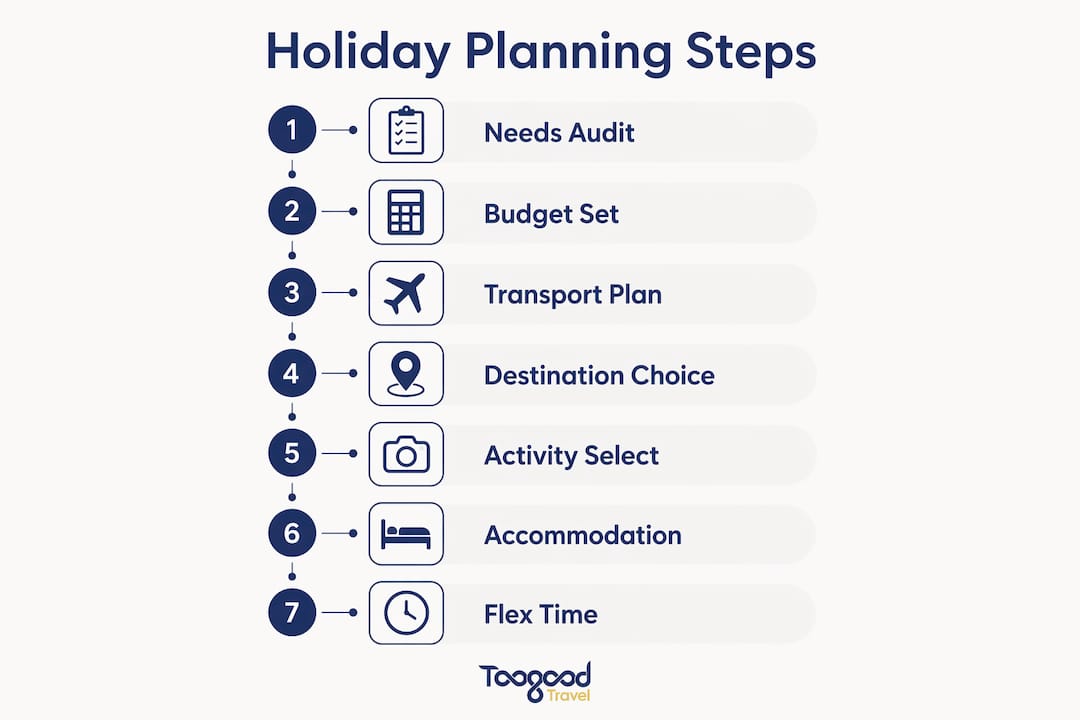
For flights, booking 4–5 months ahead secures better prices. Direct flights cost around £50 more per person but remove the stress of connections with young children. For most families, that premium is worth every penny.
Destination suitability
Not every destination suits every family. Orlando suits theme-park lovers but exhausts families who prefer a slower pace. A villa in rural Tuscany delights adults but can frustrate children without nearby activities. Match the destination to the majority of the group’s preferences, then build in enough variety to keep everyone engaged.
| Planning factor | Key consideration |
|---|---|
| Ages and mobility | Check step-free access, nap-friendly schedules, and teen autonomy options |
| Budget | Use railcards, book flights early, and factor in kids’ discounts |
| Destination fit | Match pace and activity type to the majority of the group |
| Accommodation | Prioritise space, kitchen access, and proximity to activities |
| Travel timing | School holidays push prices up; mid-term breaks offer better value |
Pro Tip: Book accommodation with a kitchen or kitchenette. Self-catering one or two meals a day cuts food costs dramatically and gives you flexibility when children are tired or fussy.
How do you create a personalised family travel itinerary step by step?
The most effective method for building a daily family travel schedule is the 1-1-1 planning rule: one main activity, one optional activity, and one planned meal per day. This structure prevents over-scheduling while keeping the day purposeful. It is the closest thing to a universal framework for family holiday planning.
The step-by-step process
Identify your anchor activities. Choose one or two experiences that the whole trip is built around. A safari in South Africa, a day at Walt Disney World in Orlando, or a boat trip in Croatia. These anchors give the holiday its identity and get everyone excited from the start.
Apply the 1-1-1 rule to each day. Slot one main activity (a theme park, a museum, a beach), one optional activity (a short walk, a market visit, a swim), and one planned meal. The optional activity can be dropped without derailing the day.
Alternate busy days with rest days. Effective family scheduling alternates high-energy days with slower, flexible ones. A full day at a water park followed by a beach morning and afternoon pool time is far more sustainable than two consecutive full-day excursions.
Assign ownership of different parts of the day. Dividing responsibility between adults reduces stress and creates genuine downtime. One adult handles morning logistics; the other manages the afternoon. This approach prevents one parent from carrying the entire mental load.
Build in free time deliberately. Unscheduled time is not wasted time. Children often have their best holiday moments during unplanned hours at a pool or exploring a market. Leave at least two hours of free time in every day.
Use a digital tool to centralise bookings. Google Sheets, Apple Notes, or a dedicated travel app keeps confirmation numbers, addresses, and timings in one place. Share it with every adult in the group so no one is dependent on a single person’s phone.
Pro Tip: Hold a short family planning meeting before you travel. Let each person choose one activity they want to do. Children who feel heard are far easier to manage when the day does not go exactly to plan.
A well-structured travel itinerary reduces holiday stress significantly, particularly for families with young children who thrive on predictability. Structure does not mean rigidity. It means having a plan you can deviate from confidently.
How do you adapt your itinerary for multi-generational trips?
Multi-generational holidays are the most logistically complex family trips to plan. You are balancing the energy of toddlers, the independence of teenagers, and the pace of grandparents, often across a single property and shared meals. The good news is that with the right approach, these trips produce the most memorable family experiences of all.
Accommodation is the foundation
Properties with multiple communal spaces and separate breakout rooms are the single most important factor in a successful multi-generational trip. A large villa with a shared living area, a separate snug, and private bedrooms for each family unit allows everyone to socialise when they want and retreat when they need to. Cramming three generations into a standard hotel suite is a recipe for friction.
Look for properties that offer:
- Separate sleeping areas for each family unit
- A shared outdoor space such as a garden or pool terrace
- A kitchen large enough for group meals
- Ground-floor rooms or lift access for older or less mobile guests
- Proximity to both quiet areas and child-friendly activities
Activity planning across age groups
Plan at least one shared activity per day that genuinely works for all ages. A boat trip, a cooking class, or a visit to a local market tends to appeal across generations. Then allow each group to split off for age-appropriate activities. Teenagers might explore independently; grandparents might prefer a café and a slow walk. Flexibility is the key ingredient.
Cost sharing on multi-generational trips requires a clear conversation before you travel. Agree on how shared costs such as villa hire, group meals, and car hire will be split. Ambiguity around money creates tension faster than almost anything else.
Pro Tip: Pack a compact, cabin-sized stroller for toddlers. Compact strollers around 12×34 inches fit in overhead lockers and remove the stress of checking bulky equipment. Pair this with a planned snack strategy and a first-aid kit kept in your hand luggage.
What are the most common mistakes when building a family holiday itinerary?
“Successful family itineraries need balance. Too many activities exhaust rather than refresh. The families who enjoy their holidays most are the ones who planned less than they thought they needed to.”
Over-scheduling is the most common and most damaging mistake parents make when creating a custom vacation plan. The instinct to fill every hour is understandable. You have spent a significant amount of money and you want to make the most of it. But children do not experience holidays the way adults do. A packed schedule feels exciting on paper and exhausting in practice.
Avoid these common errors:
- Cramming too many paid attractions into a single day. Two activities done well beat four done in a rush. Children remember how they felt, not how many things they saw.
- Underestimating travel day logistics. Arrival days and departure days are not activity days. Build in buffer time for delays, check-ins, and settling in.
- Ignoring weather contingencies. Every itinerary needs at least one rainy-day backup plan. Indoor attractions, cooking sessions, or a film afternoon at the villa all work well.
- Failing to communicate the plan. Share the itinerary with every adult before you travel. Surprises are fun; logistical confusion is not.
- Skipping the debrief. A quick five-minute chat each evening about the next day’s plan keeps everyone aligned and reduces morning chaos.
Booking your first holiday abroad as a family introduces a layer of complexity that catches many parents off guard. Visa requirements, transfer times, and unfamiliar transport systems all need to be factored into your schedule before you arrive.
Key takeaways
Building a custom family holiday itinerary works best when you combine honest needs assessment, the 1-1-1 daily structure, and deliberate rest time to keep energy and enjoyment high throughout the trip.
| Point | Details |
|---|---|
| Start with a needs audit | Map every family member’s requirements before choosing a destination or booking anything. |
| Use the 1-1-1 rule | Plan one main activity, one optional activity, and one meal per day to prevent over-scheduling. |
| Alternate busy and rest days | High-energy days followed by slower days sustain energy across a full week or more. |
| Assign adult ownership | Divide daily responsibilities between adults to reduce stress and create genuine downtime. |
| Plan for multi-generational needs | Choose properties with separate spaces and plan at least one shared activity per day. |
What I have learned from planning family holidays
Stuart Toogood’s perspective
The families who contact Toogood Travel after a difficult holiday almost always describe the same problem. They planned too much, rested too little, and nobody felt truly in charge. The ones who come back glowing tell a different story. They had a loose structure, a couple of brilliant anchor experiences, and plenty of time to simply be together.
My honest view is that most parents underestimate how much children value unstructured time. A morning at the beach with no agenda, a spontaneous ice cream stop, an afternoon watching the world go by from a café terrace. These moments cost nothing and tend to be the ones children talk about for years.
Ceding control of parts of the day is also harder than it sounds for parents who are used to managing everything. But sharing the planning load between adults genuinely transforms the experience. When one parent is not responsible for every decision, both parents actually get to enjoy the holiday.
The best family trips I have seen are not the most elaborate ones. They are the ones where someone sat down beforehand, thought carefully about what each person needed, and built a plan that left room for life to happen.
— Stuart Toogood
Planning your family holiday with Toogood Travel
Every family is different, and the best itinerary is one built around yours specifically.

Toogood Travel specialises in creating bespoke family holidays that take the planning pressure off your shoulders. Whether you are looking for a sun-soaked all-inclusive in the Caribbean, a multi-centre adventure across Southeast Asia, or a relaxed villa holiday in the Mediterranean, the team at Toogood Travel builds trips around your family’s real needs, not a generic template. From flight selection and accommodation to day-by-day activity suggestions, every detail is handled with care. Get in touch and let us put together a family holiday worth remembering.
FAQ
What is the 1-1-1 rule for family holiday planning?
The 1-1-1 rule means planning one main activity, one optional activity, and one planned meal per day. It prevents over-scheduling while keeping each day purposeful and enjoyable for all ages.
How far ahead should families book flights?
Booking flights 4–5 months in advance secures better prices for summer family travel. Direct flights cost more but remove the stress of connections with young children.
What makes a good property for a multi-generational holiday?
The best properties offer separate sleeping areas for each family unit, a shared outdoor space, and ground-floor or lift-accessible rooms for older guests. Multiple communal spaces allow socialising and privacy in equal measure.
How do you stop a family holiday itinerary from becoming too rigid?
Build in at least two hours of unscheduled time each day and plan one rainy-day backup activity per destination. A loose structure with clear anchor activities gives the holiday shape without removing spontaneity.
Are there discounts worth using for family rail travel in the UK?
A Family and Friends Railcard costs approximately £40 and saves 30% on rail fares. Children under 5 travel free and those aged 5–15 travel at half price on the National Rail network.