
TL;DR:
- A well-structured travel itinerary reduces stress by increasing control, lowering decision fatigue, and absorbing delays. Planning with flexibility, including buffer time and one main activity per day, helps travelers enjoy their trip without overwhelm. Group travel benefits from simplified cues and explicit schedules to minimize logistical stress and disagreements.
A travel itinerary is a structured schedule of activities, timings, and logistics that directly reduces travel stress by giving you control over an otherwise unpredictable experience. The role of travel itinerary in stress reduction is well supported by psychology: planning reduces uncertainty, and uncertainty is the primary driver of travel anxiety. Research into vacation recovery tools, including the Holidaily app, confirms that structured post-trip planning reduces work-related rumination with an effect size of d = -0.67. That figure tells you something important: organisation does not just feel calming, it measurably changes how your brain processes stress.
How does a well-structured travel itinerary reduce stress?
The core mechanism is perceived control. When you map out your trip in advance, you replace open-ended uncertainty with a clear sequence of events. Fear of losing control is one of the most common triggers of travel anxiety, and a well-built itinerary directly addresses it.

Structured planning also fights decision fatigue. Every unresolved question, whether it is where to eat lunch or which museum to visit first, adds to your cognitive load. Structured frameworks counteract anxiety by breaking decisions into stages and showing you measurable progress. Seeing 80% of your trip confirmed feels genuinely reassuring.
Buffer time is one of the most underrated tools in itinerary design. A missed connection or a longer-than-expected queue does not have to derail your entire day if you have built in breathing room. Buffers absorb variability and prevent one delay from cascading into a full schedule collapse. Think of them as shock absorbers, not wasted hours.
Here is what a stress-reducing itinerary actually does for you:
- Reduces uncertainty by converting vague plans into confirmed bookings and timed slots
- Lowers decision fatigue by pre-resolving choices before you are tired and hungry
- Creates measurable progress so you feel in control rather than overwhelmed
- Absorbs delays through deliberate buffer periods between activities
- Supports mental disengagement by giving your brain a clear picture of what comes next
Pro Tip: Write down your top three priorities for each day before you travel. Your brain releases dopamine when it anticipates a reward, so a clear plan does not just reduce anxiety, it actively builds excitement.
What are the best practices for designing stress-reducing itineraries?
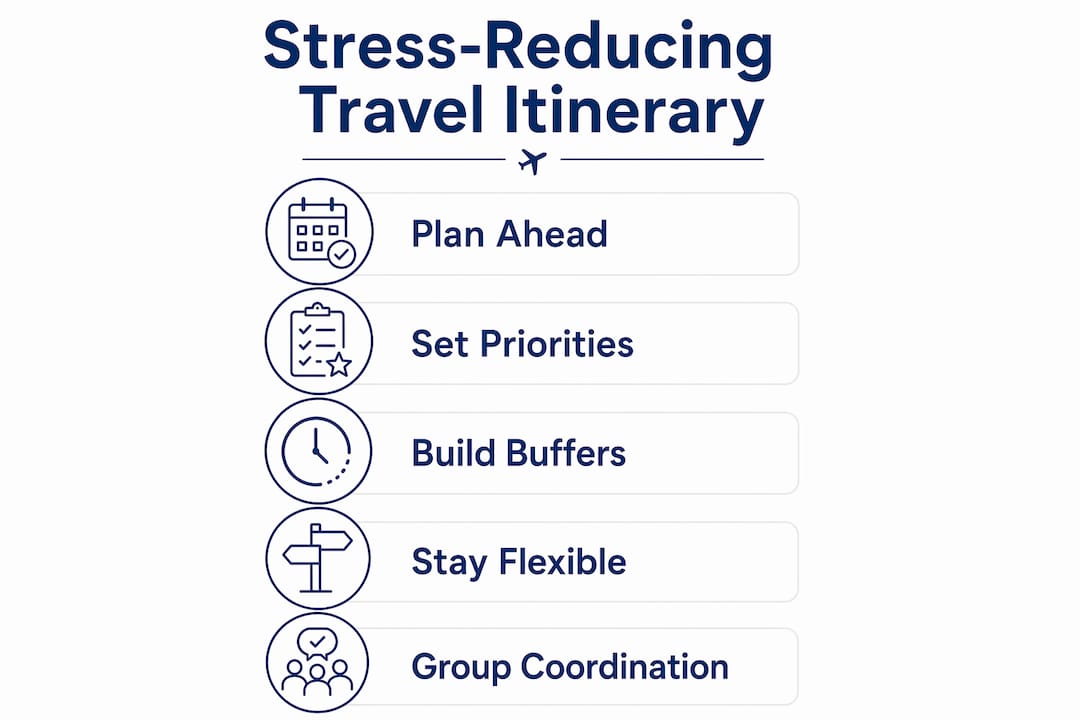
The most effective itinerary design follows one golden rule: one main activity per day, plus at least two hours of unscheduled time. That open time is not laziness. It is the buffer that keeps everything else from unravelling.
Here is a practical framework for building a balanced holiday schedule:
- Anchor each day with one headline experience. Choose one museum, one excursion, or one long lunch as the centrepiece. Everything else is optional.
- Plan around your energy patterns. If you are not a morning person, do not book a 7am guided tour. Schedule demanding activities for when you are naturally alert.
- Alternate busy and easy days. A full-day city tour followed by a beach morning keeps energy levels stable across a week-long trip.
- Build in two hours of open time daily. Use it for spontaneous discoveries, rest, or simply sitting in a café without a clock running.
- Sequence activities geographically. Group nearby attractions on the same day to cut transit time and reduce logistical stress.
- Set a hard stop for evening activities. Back-to-back dinners, shows, and night markets sound exciting in planning but create exhaustion by day four.
The importance of travel organisation becomes most obvious when you compare a packed schedule against a balanced one. Travellers who overload their itineraries often return home more tired than when they left.
Pro Tip: Rate each planned activity from 1 to 3 based on how much you genuinely want to do it. Anything rated 1 is the first to cut when the schedule feels tight.
How can groups use itineraries to manage stress and coordination?
Group travel multiplies every logistical challenge. One person running late affects everyone. One missed booking creates a ripple of frustration. A time-aware itinerary planning model, as described in a 2026 Springer Nature paper, uses explicit time-budget constraints to prevent unrealistic schedules and reduce collective stress. The principle is straightforward: if a route is not physically feasible within the available time, it should not be in the plan.
Reducing cognitive load is equally important for groups. Simpler and fewer reminders improve task execution and lower anxiety, particularly for travellers who are already prone to worry. A shared itinerary document with clear, simple cues works far better than a group chat full of conflicting suggestions.
The table below shows how group itinerary design choices affect stress levels:
| Itinerary Feature | Impact on Group Stress |
|---|---|
| Explicit time budgets per activity | Prevents unrealistic scheduling and cascading delays |
| Shared digital document | Reduces confusion and conflicting information |
| Buffer time between transfers | Absorbs individual delays without affecting the group |
| Simplified daily cues | Lowers cognitive load for anxiety-prone members |
| Geographically grouped activities | Cuts transit time and reduces logistical friction |
The benefits of travel planning for groups extend beyond logistics. A clear itinerary reduces the number of in-the-moment group decisions, which is where most travel arguments begin. When everyone already knows the plan, there is far less room for conflict.
What are the risks of overplanning and how do you stay flexible?
Overplanning is a genuine risk. Planning can backfire when it becomes an obsession rather than a preparation tool. Psychologists describe the “itinerary fixator” as someone using excessive planning as a form of control over life’s unpredictability. The result is not calm. It is paralysis.
Downtime in itineraries is a core stress-reduction practice, not a scheduling failure. The Travel Psychologist specifically advocates for unstructured time as a tool for emotional regulation during travel. Spontaneity is not the enemy of a good itinerary. It is the reward for building one well.
Here is how to keep your planning healthy rather than obsessive:
- Set a research deadline. Give yourself a fixed date to stop adding to the plan and start trusting it.
- Limit daily must-dos to three items. Anything beyond three becomes a source of pressure rather than pleasure.
- Write a transition plan before you leave. A specific activation plan that captures when and how you will handle key tasks helps your brain disengage from unresolved worries.
- Label buffer time explicitly. Call it “free afternoon” in your schedule, not a gap. Naming it makes it feel intentional rather than accidental.
- Accept that one thing will change. Build that expectation into your mindset from day one. Flexibility is a feature of a good itinerary, not a flaw.
The travel scheduling approach that works best treats the itinerary as a framework, not a contract. You are not obligated to follow it perfectly. You are using it to feel prepared enough to relax.
Key takeaways
A well-designed travel itinerary reduces stress by replacing uncertainty with structure, absorbing delays with buffer time, and freeing your mind to actually enjoy the trip.
| Point | Details |
|---|---|
| Control reduces anxiety | Mapping activities in advance lowers fear of the unknown, the primary driver of travel stress. |
| One main activity per day | Anchoring each day with one key experience prevents exhaustion and schedule collapse. |
| Buffer time is non-negotiable | Deliberate gaps between activities absorb delays and stop one problem becoming many. |
| Groups need simpler cues | Fewer, clearer reminders reduce cognitive load and lower anxiety for all members. |
| Overplanning creates its own stress | Set a research deadline and treat the itinerary as a framework, not a rigid contract. |
Why i think most travellers plan either too much or too little
After years of helping people plan their holidays, I have noticed that travellers rarely land in the middle. They either arrive with a colour-coded spreadsheet covering every 30-minute slot, or they wing it entirely and spend half the trip arguing about what to do next.
Both approaches create stress. The over-planner cannot enjoy a spontaneous lunch because it is not in the schedule. The under-planner wastes precious holiday time making decisions they could have resolved at home in five minutes.
The travellers who genuinely come back refreshed are the ones who planned with intention and then let go. They booked the big things, left the afternoons open, and trusted that a little uncertainty is part of what makes travel exciting. They also wrote things down before they left, not to control every outcome, but to clear their heads. A specific, written plan is not about rigidity. It is about giving your brain permission to stop worrying.
My honest advice: plan the structure, schedule the rest, and resist the urge to optimise endlessly. The best holiday you will ever take is the one where you actually switch off.
— Stuart
Let Toogoodtravel handle the planning for you
Crafting a balanced, stress-free itinerary takes time, knowledge, and experience. Toogoodtravel specialises in doing exactly that, building tailored holiday experiences that account for your energy levels, preferences, and pace. Whether you are travelling solo, as a couple, or with a group, we handle the logistics so you can focus on the excitement.

From flights and accommodation to guided tours and transfers, Toogoodtravel takes the guesswork out of every stage. Our poker holidays are a brilliant example of how a structured, expertly planned trip can deliver pure enjoyment without a moment of logistical stress. Ready to stop overplanning and start enjoying? Explore your next adventure with Toogoodtravel today. ✈️
FAQ
What is the role of a travel itinerary in stress reduction?
A travel itinerary reduces stress by replacing uncertainty with a clear sequence of confirmed plans, which lowers anxiety driven by fear of the unknown. Structured planning also reduces decision fatigue by resolving key choices before the trip begins.
How much free time should i leave in a daily travel itinerary?
Travel experts recommend leaving at least two hours of unscheduled time per day. This buffer absorbs delays and creates space for spontaneous experiences without derailing the wider schedule.
Can overplanning a holiday actually increase stress?
Yes. Psychologists describe “itinerary fixation” as using excessive planning to control life’s unpredictability, which often leads to paralysis and heightened anxiety rather than calm. Setting a research deadline and treating your itinerary as a flexible framework prevents this.
How do travel itineraries help groups reduce stress?
Group itineraries with explicit time budgets and simplified daily cues reduce cognitive load and prevent cascading delays. A 2026 Springer Nature study confirmed that time-aware planning models improve feasibility and satisfaction for group travel.
What is the best way to plan a stress-free holiday itinerary?
Anchor each day with one main activity, alternate busy and easy days, and build deliberate buffer time into the schedule. Writing a specific transition plan before you leave also helps your brain disengage from unresolved worries and arrive on holiday mentally ready to relax.
