
TL;DR:
- The dry season from November to April offers the best weather, calm seas, and high underwater visibility in the Maldives.
- Shoulder seasons provide significant savings with good conditions, while the wet season is ideal for marine encounters and lower prices.
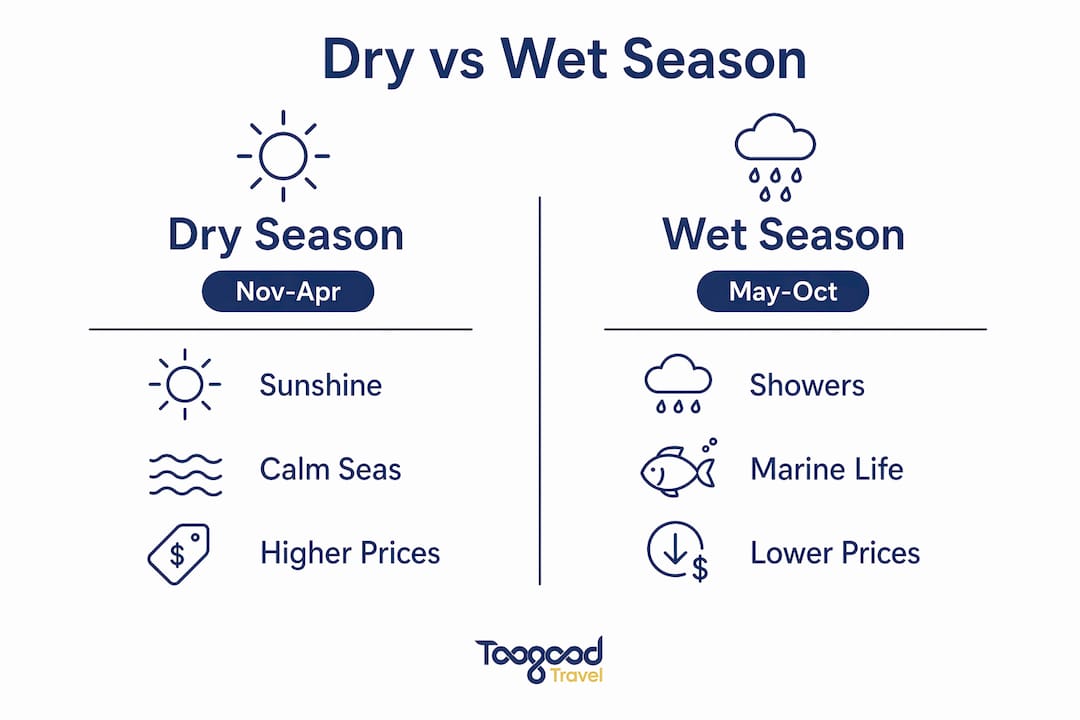
The best time to travel to the Maldives is during the dry season, from november to april, when reliable sunshine, calm seas, and outstanding underwater visibility of 30 or more metres make every day feel effortless. Locally, this period is known as Iruvai, the northeast monsoon season. Peak months from december to march bring the most stable weather but also the highest resort prices and the largest crowds. Shoulder seasons and the wet season each offer genuine trade-offs in cost, weather, and marine life encounters. Knowing which window suits your priorities is the difference between a good trip and an exceptional one.
What makes the dry season the best time to visit the Maldives?
The dry season from november to april delivers the most consistent travel conditions the Maldives offers. Clear skies and warm temperatures of 28–30°C combine with sunshine averaging 7–9 hours daily. Seas stay calm, and underwater visibility regularly exceeds 30 metres, making this the prime window for diving and snorkelling.

December to march is the most sought-after period within the dry season. Coral reefs are at their most vivid, whale sharks cruise the atolls, and the Indian Ocean sits almost flat. That combination draws travellers from across Europe, the Middle East, and Asia simultaneously.
The demand has a direct impact on price. Peak months require bookings 3–6 months ahead for the best rates and availability. Prices over christmas and new year can run two to three times higher than the rest of the year. Book early or expect to pay a significant premium for the same overwater villa.
| Month | Avg Temp (°C) | Sunshine (hrs/day) | Rain Risk | Crowds | Key Activity |
|---|---|---|---|---|---|
| November | 29 | 7 | Low | Moderate | Snorkelling, diving |
| December | 29 | 8 | Very low | High | All water sports |
| January | 28 | 9 | Very low | Very high | Diving, whale sharks |
| February | 28 | 9 | Very low | Very high | Diving, snorkelling |
| March | 30 | 8 | Low | High | Surfing begins |
| April | 31 | 7 | Low to moderate | Moderate | Snorkelling, surfing |
Pro Tip: Book your Maldives resort for december to february at least five months in advance. The most popular overwater bungalows at sought-after atolls sell out first, and last-minute availability at this time of year is rare.
How do shoulder seasons balance budget and good weather?
Shoulder seasons sit in two windows: late april to early may, and late november to early december. These periods offer near-dry-season weather with noticeably lower costs and fewer guests at the resorts.
Resort prices during shoulder seasons drop by 40–50% compared to peak february rates. That is a substantial saving on a destination where nightly rates for overwater villas routinely run into hundreds of pounds. The weather remains warm and largely sunny, with only occasional short afternoon showers interrupting otherwise clear days.
The late november window is particularly attractive. The dry season is just beginning, resorts are not yet at capacity, and the ocean has settled from the wet season swell. Many experienced travellers consider this the highest value-to-experience window the Maldives offers. The late april window suits those who want to catch the tail end of peak conditions before prices climb back down.
Pros and cons of shoulder season travel:
- ✅ Resort rates 40–50% lower than peak season
- ✅ Fewer guests at pools, beaches, and dive sites
- ✅ Good underwater visibility still available
- ✅ Easier to secure preferred room categories
- ❌ Occasional short rain showers possible
- ❌ Some resort amenities may operate on reduced schedules
- ❌ Slightly higher humidity than peak dry season months
Pro Tip: If you are travelling around easter or just before the Asian summer holiday period, you sit in a shoulder window that experts consistently recommend for value. You get excellent conditions without the peak-season price tag.
Who should consider visiting during the wet season?
The wet season runs from may to october and is defined by the southwest monsoon, known locally as Hulhangu. Rain arrives in brief tropical bursts rather than sustained downpours. Showers typically last 1–2 hours before sunshine returns, meaning most of your day remains usable. Sea temperatures hold steady at around 28°C throughout.
Resort rates during the wet season fall 30–50% below dry season prices. For travellers with flexibility on dates, this is the most affordable window to experience luxury Maldives resorts. Fewer guests also means more attentive service and quieter beaches.
The wet season is not simply a budget option. It is the best time for specific marine encounters that the dry season cannot match. Surfing peaks from june to august, with the North and South Malé Atolls producing consistent swells. Manta ray and whale shark sightings peak from august to november, particularly at Baa Atoll’s Hanifaru Bay, a UNESCO Biosphere Reserve. These encounters draw dedicated divers and snorkellers who plan their entire trip around them.
| Factor | Dry Season (Nov–Apr) | Wet Season (May–Oct) |
|---|---|---|
| Weather reliability | High | Moderate |
| Resort prices | High to very high | 30–50% lower |
| Crowds | High | Low |
| Underwater visibility | Excellent (30+ metres) | Good to moderate |
| Surfing conditions | Poor to moderate | Excellent (Jun–Aug) |
| Manta ray/whale shark | Occasional | Peak (Aug–Nov) |
| Rain disruption | Minimal | Brief daily showers |
Wet season travel tips:
- Pack a light waterproof layer for afternoon showers
- Book dive trips in the morning when conditions are calmest
- Target Baa Atoll for manta ray snorkelling between august and october
- Confirm holiday protection cover before travelling, as weather-related disruptions are more common
- Check resort activity schedules, as some water sports operate on reduced hours
How to choose the right time based on your priorities
The ideal travel window depends entirely on what you want from your trip. Matching your priorities to the right season removes guesswork and protects your budget.
Step-by-step decision guide:
Prioritise perfect weather above all else. Choose january or february. These months deliver the most stable conditions, the highest sunshine hours, and the calmest seas. Book 5–6 months ahead and expect premium pricing.
Prioritise value without sacrificing quality. Choose late november or late april. Shoulder season pricing is 40–50% lower than peak rates, weather remains largely favourable, and resorts are noticeably quieter.
Prioritise marine life encounters. Choose august to october for manta rays and whale sharks at Hanifaru Bay. Accept that brief rain showers are part of the experience and that visibility may be slightly reduced compared to the dry season.
Prioritise surfing. Choose june to august. The southwest monsoon generates the best swells of the year, and surf camps around the atolls operate at full capacity during this window.
Prioritise avoiding crowds. Choose may or june. These months sit at the start of the wet season, when resorts are at their quietest and prices are at their lowest. Weather is warm, and the ocean is still swimmable.
One practical detail many travellers overlook: some resort operators adjust their local time by 1–1.5 hours ahead of Malé Time to extend daylight for guests. This affects speedboat transfer schedules and excursion timings. Always confirm your resort’s operating time zone before you arrive to avoid missing a transfer or a sunrise dive.
For first-time visitors, the holiday planning checklist from Toogood Travel covers the practical preparation steps that make a real difference, from documentation to transfer logistics.
Key takeaways
The dry season from november to april is the best time to visit the Maldives, but shoulder seasons offer 40–50% lower prices with near-identical weather, making them the strongest choice for value-focused travellers.
| Point | Details |
|---|---|
| Dry season is the gold standard | November to april brings sunshine, calm seas, and 30+ metre underwater visibility. |
| Peak months cost significantly more | December to march prices can run two to three times higher than the rest of the year. |
| Shoulder seasons offer the best value | Late november and late april deliver good weather with resort rates 40–50% lower than peak. |
| Wet season suits niche travellers | Surfers and marine life enthusiasts get the best conditions from june to october. |
| Book peak season early | Secure december to february bookings at least 5–6 months ahead for best availability and rates. |
My honest view on Maldives timing
Most travel advice stops at “go in the dry season.” That is technically correct, but it is also incomplete. I have seen travellers spend twice the budget for a january trip that looked almost identical to a late november trip booked at half the price. The Maldives does not dramatically change between those windows. The water is still warm, the reefs are still stunning, and the overwater villas are just as beautiful.
The misconception I encounter most often is that the wet season means a ruined holiday. It does not. A two-hour afternoon shower followed by golden light and a flat ocean is not a disaster. It is a Maldives afternoon. Travellers who go in september for the manta rays at Hanifaru Bay often describe it as the most memorable wildlife experience of their lives, and they paid a fraction of the peak-season rate.
What I genuinely believe is underrated: visiting a local island alongside your resort stay. Most visitors never leave the resort island. The local culture and community of the Maldives is warm, fascinating, and completely missed by the majority of tourists. A half-day trip to a local island adds real depth to any trip, regardless of season.
Time zone differences between resorts and Malé are also something I always flag to clients. Missing a speedboat transfer because you did not know your resort runs 1.5 hours ahead of Malé Time is an avoidable frustration. Check it before you travel.
— Stuart Toogood
Plan your Maldives trip with Toogood Travel
Knowing the best season is one thing. Turning that knowledge into a perfectly timed, well-priced Maldives holiday is another. Toogood Travel specialises in exactly that, building tailored Maldives packages that match your preferred travel window, budget, and must-have experiences.

Whether you are eyeing a peak-season overwater villa for a honeymoon or a shoulder-season dive trip at a fraction of the price, Toogood Travel’s network of trusted resort partners and exclusive deals delivers options that generic booking platforms simply cannot match. Every booking comes with full ATOL and PTS protection, flexible cancellation terms, and personal support from start to finish. Plan your next adventure with Toogood Travel and get the Maldives trip you actually want, at the right time and the right price.
FAQ
When is the best time to visit the Maldives for good weather?
The best months for reliable sunshine and calm seas are december to march, when temperatures sit at 28–30°C and sunshine averages 7–9 hours daily. January and february are the most stable months of the year.
What is the cheapest time to visit the Maldives?
May to october offers the lowest resort rates, with prices 30–50% cheaper than the dry season. Brief tropical showers are common but rarely disrupt a full day.
When is the best time for a Maldives honeymoon?
January and february are the most popular months for a Maldives honeymoon due to near-perfect weather and calm seas. Book at least five months ahead, as peak demand makes availability tight and prices high during this period.
When can I see manta rays and whale sharks in the Maldives?
Manta ray and whale shark encounters peak from august to november, with Baa Atoll’s Hanifaru Bay offering the most reliable sightings. This falls within the wet season, so expect lower resort prices alongside the marine life activity.
How far in advance should I book a Maldives holiday?
For december to march travel, book 3–6 months ahead to secure the best rates and room availability. Shoulder season bookings offer more flexibility, though popular resorts still fill quickly around easter and school holiday periods.
