
TL;DR:
- Destination guides help travelers expand their choices by revealing unplanned places and practical details they might overlook. They reduce information overload through curated advice, allowing for efficient planning and personalized itineraries. Expert guides outperform AI and crowd sources in providing trustworthy, contextual recommendations for leisure travel.
Destination guides are curated resources that combine expert advice, practical organisation, and local insight into one accessible tool, giving travellers a structured foundation for every stage of holiday planning. A striking 72% of surveyed travellers used physical brochures, maps, or guides to plan or navigate their trips, confirming that these resources remain genuinely relevant in the digital age. The role of destination guides in holiday decisions goes far beyond listing attractions. They help you filter noise, avoid costly mistakes, and build a trip that matches your expectations before you spend a penny. Whether you are planning a city break in Tokyo or a beach holiday in the Maldives, a well-written guide transforms a daunting research process into a confident, enjoyable experience.
Why destination guides help holiday planning by expanding your choices
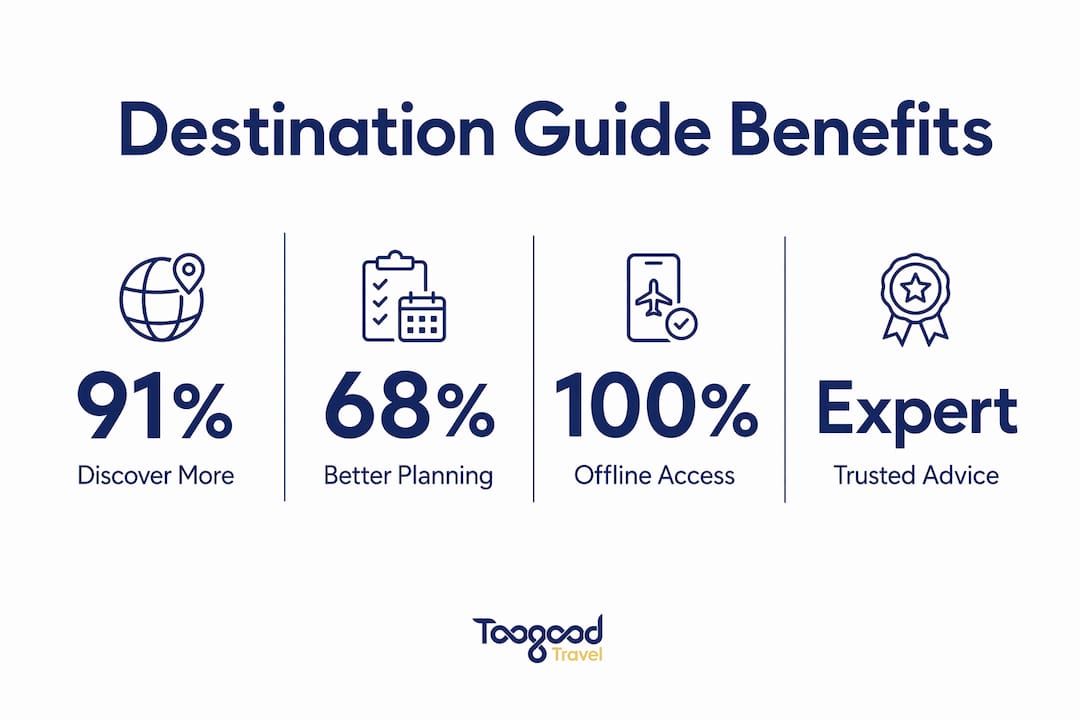
The most underappreciated benefit of destination guides is how they push your thinking beyond your first instinct. Among travellers who used brochures and guides, 91% discovered unplanned places they had not originally considered. That figure is remarkable. It means that for nine out of ten travellers, a guide directly changed what they did or where they went.

This matters because most travellers start with a vague idea rather than a firm plan. Research shows that 68% of travellers have not settled on a destination even after they begin looking at flights. A destination guide steps in at exactly this moment, presenting options with enough context to help you compare and commit. It does not just list places. It explains the atmosphere, the trade-offs, and who each destination suits best.
Guides also protect you from hidden costs that general searches miss. A well-researched guide will flag that a resort town in Greece charges a premium for beachfront dining, or that a popular temple district in Kyoto requires a paid entry pass during peak season. These details rarely appear in a standard internet search but appear consistently in expert-written travel guides.
Here is what a good destination guide does that a search engine cannot:
- Introduces you to lesser-known areas within a destination that suit your travel style
- Explains the practical difference between two similar-sounding regions (such as Krabi versus Phuket in Thailand)
- Flags seasonal considerations that affect value, crowds, and weather
- Highlights hidden costs, entry requirements, and local customs that affect your budget
Pro Tip: When using a destination guide to choose between two locations, read the “who is this for” section first. That single paragraph often saves hours of comparison research.
How do destination guides reduce information overload?
Digital research is fast but frequently chaotic. A search for “best things to do in Bali” returns thousands of results, many of which contradict each other or push sponsored content. This volume creates planning paralysis rather than clarity.
Destination guides solve this through what travel researchers call curated restraint. Rather than presenting every option, a guide filters information down to what is genuinely relevant for the type of traveller you are. That restraint is not a limitation. It is the entire point.
The most effective way to use a guide during planning follows a clear sequence:
- Read the overview section first. This gives you the destination’s character, best travel season, and general cost level before you commit to anything.
- Use the suggested itineraries as a backbone. These are built by people who have visited, tested, and revised. They prevent you from accidentally spending two days in the wrong area.
- Identify your must-see and nice-to-see priorities. A good guide separates iconic sights from optional extras, helping you allocate time realistically.
- Note the practical sections. Transport, tipping culture, local laws, and currency advice all appear in guides and are frequently absent from blog posts.
- Layer digital research on top. Once your structure is set, use current reviews and social media to refine restaurant choices or check recent opening hours.
This sequencing prevents disjointed planning and stops you from building an itinerary around a restaurant that closed six months ago. The guide provides the skeleton. Digital tools add the flesh.
Pro Tip: Treat the guide’s suggested itinerary as a starting point, not a rigid schedule. Highlight the sections that match your interests and cross out anything that does not. You will end up with a personalised plan in under an hour.
Are expert-written guides more trustworthy than AI or crowd-sourced advice?
For leisure travel, expert-written guides outperform both AI recommendations and crowd-sourced platforms in one critical area: context. Research published in PLOS ONE confirms that travellers favour expert recommendations over AI-generated advice for hedonic, pleasure-based trips. AI performs well for utilitarian tasks like booking logistics, but it struggles to convey the feel of a place or the nuance of choosing between two neighbourhoods.
Crowd-sourced platforms have a different problem. They aggregate opinions without editorial judgement, which means a five-star review and a one-star review carry equal weight. A traveller who visited during a building renovation and a traveller who visited during peak season are both contributing to the same average score.
Professional destination guides address this through editorial independence. Reputable guides do not accept payment for positive coverage. Their recommendations reflect genuine visits, local knowledge, and consistent editorial standards. That independence is what makes their advice reliable rather than promotional.
The specific advantages of expert-written guides include:
- Local voice and cultural context. A guide written by someone who has lived in or repeatedly visited a destination captures atmosphere that no algorithm can replicate.
- Honest trade-offs. Expert guides tell you when a famous sight is overrated, when a beach is overcrowded in july, or when a neighbourhood is better for nightlife than for families.
- Consistent quality standards. Editorial teams apply the same criteria across every destination, so you can trust that a “highly recommended” label means the same thing in Lisbon as it does in Lima.
How to use travel guides effectively on the ground
Knowing the benefits of destination guides is one thing. Using them well during your actual trip is another. The most practical application is treating a physical guide as your offline anchor.
Physical guidebooks never lose signal and never run out of battery. In remote areas of Iceland, rural Vietnam, or the Greek islands, this is not a minor convenience. It is the difference between finding your accommodation and being genuinely lost. A physical guide also holds emergency information, local emergency numbers, and transport maps that remain accessible when your phone cannot connect.
Beyond emergencies, guides serve a daily orientation function. The table below shows how different sections of a destination guide map to specific planning and on-the-ground needs.
| Guide section | When to use it | What it solves |
|---|---|---|
| Overview and introduction | Before booking | Confirms the destination matches your travel style and budget |
| Suggested itineraries | During planning | Builds a realistic daily schedule without wasted time |
| Neighbourhoods and areas | When choosing accommodation | Identifies the right base for your priorities |
| Local customs and language | Before departure | Prevents cultural missteps and builds rapport with locals |
| Hidden gems and local tips | On the ground | Adds memorable, off-the-beaten-track moments to your trip |
| Emergency and practical info | Throughout the trip | Provides offline access to transport, health, and safety details |
Many travellers also find that guidebooks grow in value after the trip ends. Personal notes, ticket stubs, and handwritten additions transform a guide into a unique travel memoir. That is a dimension no app or website can replicate.
For first-time travellers abroad, pairing a destination guide with structured holiday planning advice makes the entire process feel far less daunting. The guide handles the destination knowledge. Structured planning advice handles the logistics.
Key takeaways
Destination guides are the single most effective tool for turning vague holiday ideas into confident, well-structured travel plans.
| Point | Details |
|---|---|
| Guides expand your choices | 91% of guide users discover unplanned places, broadening trips beyond initial ideas. |
| Curated restraint saves time | Guides filter vast information into relevant facts, preventing planning paralysis. |
| Expert advice beats algorithms for leisure trips | Research confirms travellers trust expert recommendations over AI for pleasure-based holidays. |
| Physical guides work offline | Guidebooks provide reliable navigation and emergency information when digital tools fail. |
| Use guides as a planning backbone | Build your itinerary structure with a guide first, then refine with real-time digital research. |
Why I still reach for a destination guide before I reach for a search engine
Stuart Toogood here. After years of planning holidays for travellers across every continent, I have watched the same pattern repeat itself. The travellers who arrive at their destination with the most confidence are almost always the ones who spent time with a proper destination guide before they opened a browser tab.
The travellers who skip guides tend to arrive with a loose list of things they have seen on social media. They spend the first two days reorienting themselves, realising that the beach they planned to visit is a three-hour drive from their hotel, or that the restaurant they saved is closed on Tuesdays. These are not catastrophic mistakes, but they chip away at the experience.
What I find guides do better than anything else is help travellers picture the trip honestly. Not the filtered, highlight-reel version you see online, but the real version: the distances, the trade-offs, the moments that are genuinely worth your time versus the ones that look better in photographs than they feel in person. That honest picture is what separates a good holiday from a great one.
My advice is simple. Use a destination guide to build your framework, then use digital tools to keep it current. A well-structured travel itinerary built on solid guide research reduces stress before you even pack your bag.
— Stuart Toogood
Planning your next holiday with Toogood Travel
Destination guides give you the knowledge. Toogood Travel gives you the holiday.

At Toogood Travel, every package is built around the kind of curated, expert knowledge that the best destination guides are known for. Whether you are drawn to a vibrant city break, a luxury beach escape, or a worldwide cruise adventure, the team brings genuine destination expertise to every booking. You will not be handed a generic package and left to figure out the details. You will get a holiday shaped around what you actually want, backed by people who know these destinations well. Visit the Toogood Travel holiday finder to browse curated options across every corner of the world and take the first step towards a trip you will genuinely love.
FAQ
What is a destination guide?
A destination guide is a curated resource covering a specific location’s attractions, culture, transport, accommodation, and practical travel advice. It is designed to help travellers plan and navigate their trips with confidence.
Why do destination guides help with holiday planning?
Destination guides filter vast amounts of information into relevant, structured advice, helping travellers make faster and better-informed decisions. Research shows that 91% of guide users discover places they had not originally planned to visit.
Are physical guidebooks still worth using?
Physical guidebooks remain valuable because they work offline, never lose battery power, and provide reliable emergency and navigation information in areas with poor signal. They are particularly useful in remote or rural destinations.
How do expert guides compare to AI travel recommendations?
Research published in PLOS ONE confirms that travellers prefer expert recommendations over AI-generated advice for leisure holidays. Expert guides offer cultural context, honest trade-offs, and editorial independence that AI currently cannot match.
How should I combine a destination guide with digital research?
Use the guide to build your itinerary structure first, covering areas, timings, and priorities. Then layer current digital research on top to check recent reviews, opening hours, and any changes since the guide was published.
